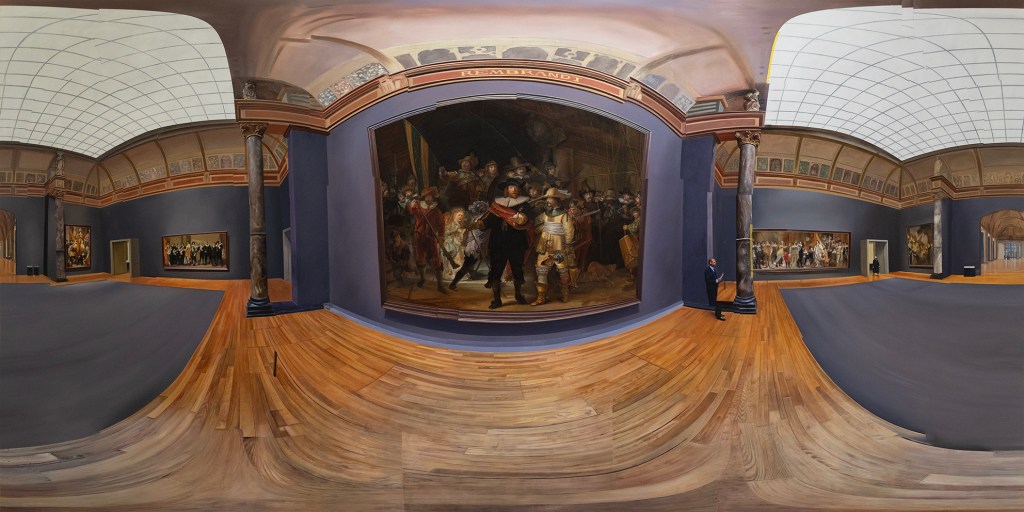
Here you can see the painting in 3D/Virtual Reality (with or without glasses): https://tour.panoee.net/69380de414b9870cedc15a9f
(work in progress)
Rembrandt’s Night Watch in 360 Degrees is a 150 x 300 cm painting, begun in 2018, that explores the boundaries between painting, panoramic photography, and virtual reality. The work is part of the ongoing Universal Painting Project 360VR, first presented to the public at KunstRAI Amsterdam in 2018, where it received an enthusiastic response from visitors.
The project depicts the entire gallery of the Rijksmuseum where The Night Watch is displayed, transformed into an immersive 360-degree environment. At its center, Rembrandt’s masterpiece has been meticulously reproduced and anamorphically distorted to integrate into a spherical spatial system. The composition is based on a panoramic image captured with a mobile phone, whose recording errors, temporal shifts, and spatial discontinuities were deliberately incorporated into the painting process.
The only human presence is the gallery attendant, who appears fragmented and repeated by the logic of the panoramic capture. These visual disruptions are not treated as technical flaws but as evidence of a new way of seeing and constructing images.
The work proposes that we are witnessing the emergence of a new visual language. If traditional Euclidean representation was organized through the composition of the image, Universal Painting Project 360VR investigates perception through its decomposition. Fragmentation, distortion, multiple viewpoints, temporal dislocations, and immersive space become the building blocks of a new pictorial grammar.
As noted in the artist’s statement from 2017: “If, in the Euclidean world of two-dimensional representation, we perceived through the concept of image composition, with Universal we perceive through its decomposition.”
The project exists simultaneously as a physical painting and as an immersive virtual reality experience. Rather than replacing painting with technology, it expands painting into a new perceptual territory where classical art, digital imaging, and virtual space converge. More than a reinterpretation of Rembrandt’s The Night Watch, the work proposes an expansion of its spatial, temporal, and perceptual dimensions, transforming a historical masterpiece into a contemporary immersive experience.

